Yvette Coppersmith is an outstanding female painter whose work is joyous, exuberant and evocative. She has won a string of awards including the inauguralMetro Art Award and has been an Archibald finalist on numerous occasions most recently withher portrait of John Safran(now returned home at Chalk Horse post tour).
This new body of work she has imagined is a series of portraits, not of people, but of the habitat as an articulation of personal culture and self.
Loft Suitehas been constructed over an evening known asThe Lock Inwhere in a dodgy St Kilda avenue laden with street workers, above a butcher shop lies a creative oasis where some of Melbourne’s last bohemians come together. In the apartment lives a PHD candidate in architecture and a multimedia artist and the two have created a richly textured and culturally dynamic space. Coppersmith captures this with aplomb encapsulating a kind of prophetic nostalgia at the freedom of youth and artistic engagement at its most wonderful: the art of conversation and sharing.
Somehow the absence of figures make the scenes not so much isolating or alienating, but rather there is a sense of putting yourself into these scenes; Coppersmith spreads this sense of the artistic community through to the viewer and warmly invites you to contemplate the culinary offerings of the pots and pans as well as the sounds emitted from the turntables.
Triplicated is an exploratory exhibition on the nexus of art and law. Tim Gregory, Janet Chan, and Oliver Watts all lecture, study and research, in one way or another at the University of New South Wales. On realising their shared interest in visual culture and the law they decided to mount this exhibition. As part of this collegiate spirit Gregory and Watts reprised their roles as co-lecturers to expand on the exhibition at the opening through a lecture/performance/opening statement.
Dane Lovett "Last Days"2010 152cm x 152cm Acrylic on Canvas
Julian Meagher "Born To Breed" 2010 120cm x 120cm Acrylic on Canvas
The Metro Art Award is a painting prize and has been running since 2003 with the inaugural winner being another Chalk Horse represented artist Yvette Coppersmith. Now in its 8th year, the Metro Art Award is one of Australia's richest art awards for emerging artists and has helped launch the careers of many past winners and finalists alike. Chalk Horse artist Fergus Binns notably won the award in 2008 receiving great critical response for his work and airtime on the abc. His recent show with us in February was a breakout entitles "Toy Paintings". Binns has a really interesting take on painting as a medium; "Natural elements won't decay the painting/materials over a short time with the conservation of artwork making them last perhaps thousands of years beyond myself, which I have trouble accepting. So, I have incorporated that as a kind of acknowledgment of my own mortality and that of the painting, and by killing or mummifying the image I find it easier to accept that, I’m getting older, decaying and one day I’ll die and fuck you painting, I’ll kill you before you kill me, but I'm glad you will live on."
Fergus Binns "Artist Canvas" 2009 mixed media in canvas 50 x 50 cm
For this year's award, the former Victorian Premier Jeffrey Kennett will head the judging panel and three other judges have been brought in to decide upon the winning entries. 27 finalists have been selected for 2010 and are to be exhibited to a nation wide audience for three weeks at Metro Gallery.
2003 winner Yvette Coppersmith has a forthcoming exhibition at Chalk Horse to be onpened on July 22 entitled "Loft Suite" with a sneak preview below.
The Problem of Asia ran at Chalk Horse courtesy of Para/Site Hong Kong from April through to May 2010.
Ai Weiwei, Beijing Ring Roads II, video (installation view)
The show featured Ai Weiwei, Tintin Wulia, Dinu Li, Huang Xiaopeng, Leung Chi Wo, Michael Lee and was curated by Alvaro Rodriguez Fominaya.
New Yorker writer Evan Osnos featured a dynamic profile piece on Ai Weiwei in a May 2010 edition of the magazine and recorded an accompanying video to the piece.
Jasper Knight and Alvaro Rodriguez Forminaya in front of Huang Xiaopeng's You are the Dream of My Realisation (2010), vinyl wall installation.
Chalk Horse Preview Guests
Alvaro Rodriguez Forminaya and Preview Guests
Michael Lee Spiral Supermart (2010) Digital Print
Tintin Wulia (Re)Collection of Togetherness- Stage 5 (2010) Installation of ten tables and fake passports from an ever-growing number of countries.
Luke Ching Chin-wai Easy to Learn Cantonese (I Love You)- Japan Version (2006) Video
Chalk Horse and Para/Site "The Problem of Asia" team
Michael Lee, Leung Chi Wo, Alvaro Rodriguez Forminaya and Huang Xiaopeng in front of Huang Xiaopeng's You are the Dream of My Realisation (2010), vinyl wall installation.
Tintin Wulia (Re)Collection of Togetherness- Stage 5 (2010) Installation of tentables and fake passports from an ever-growing number of countries.
Keep your eyes peeled for Sam Doctor our next show and please join us for drinks for an exclusive preview and to meet the artist this Thursday April 15th from 6pm to 8pm.
The exhibition will continue through until April 24th.
A Song for the Stone-breakers is a video installation capturing the working environment of sulphur minors in Kawah Ijen, Indonesia. The work observes the ongoing confrontation and overwhelming tensions in working conditions in Kawah Ijen, Indonesia focusing on the risks and consequences of work in situations where conditions are almost impossible. A song for the- Stone breakers questions the ideas and notions of repetition in manual labour including the universal tension drawn out between humankind and the environment, the related psychodynamic tension that hides in the mankind’s awareness of his fragility in the face of natural forces. The interests are in the dual themes of risk and futility in what I call ‘the dark, Faustian side of human nature in the will to contain what it cannot contain.’
A song for the Stonebreakers focuses on environmental hazards; the work emits a sense of vulnerability and threat. The title of my work also reveals a process of thought on the part of me being a artist: it suggests a narrative, which, by virtue of being withheld, is intended to draw the viewer into a place of reverie. The title additionally reflects on Gustave Corbet’s 1849 realist masterpiece The Stone Breakers, . In the video artwork the footage of the uncanny location in Indonesia is juxtaposed with a succession of imagery of sulphur miners using primeval excavation methods in illegal mines in the Indonesia. Where workers suffer the perils of neo-imperialism and profiteering multinationals a tension in the work asks the observer to query what may lie beneath the surface, to explore unknown territories, unrestrained nature and the consequences for mankind. In this particular work I am reflecting on a sobering subject matter but allowing the viewer various states of contemplation and deliberation.
Sam Doctor will be speaking on Eastside Radio this Thursday on Arts Thursday 89.7 FM with Nicholas Hose and Clementine Blackman about Stonebreakers between 9:30am and 11:30am.
Tune in for a sneak peak into Doctor's brain before the opening!
Mount Kosciusko was for you quite a serious piece that brought you your first award. How has your sense of social commentary shifted from something quite environmentally focused towards what you are nutting out in ‘Toy Paintings’?
Its quite difficult to say specifically. I felt the natural urge to open new books and move into a more uncomfortable space. I decided to let my guard down and everything which I’m informed by has kind of been coming out like a brain blunder. I feel like I’ve lost some control of it, or had it all and have dropped it and am trying to reassemble it in some sort of order. I think the social commentary comes into it a little bit more ambiguously though, as there are other more philosophical and psychological interferences coming in.
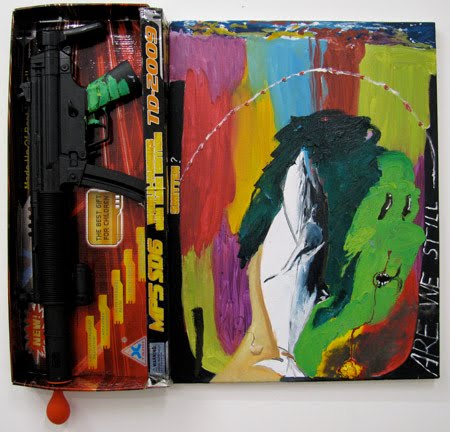
Are We Still Smitten?, 2010
‘Toy Paintings’ is a delicious collection of multicoloured nightmares, fantasy and has a terrific sense of humour running through its veins. What is the thrust of your joke in something like ‘are we still smitten’?
I always battle positive and negative charges. There are moments when I am thinking about something, which is very serious, a serious issue or a serious image. I think when you think of horrible things so deeply and intensely they start to become quite absurd. So, I guess when an idea or theme is so unravelled it starts to turn into a joke gone too far perhaps? Its probably just a way of making sense of things, or accepting that a lot of things just don’t make sense and that’s just something which has to be accepted. In a work like Are we still smitten, the painting of the whale was an old work with just the dead whale and bright colours around it. I think I picked it up and thought to the whales and artwork: ‘Are we still smitten?’...If I shoot you with this machine gun or throw fresh water bombs at you will we still be smitten? ... Although I also think I might have been thinking about a person and wondering if we are still smitten??
The antipodeans of Post War Australian art were trying to imbue Australia with a sense of history by cultivating its mythology. What are you saying about mythicism in Australian culture?
I have looked at many Australian artists over the time who have developed their practice around this form of art- story telling. I find it hard to really relate to any existing mythologies in Australia or from anywhere else so am playing with the idea of feebly attempting to tap into a potentially mythological present. But, this proves to be an almost impossible task and often comes out as something banal, fickle and jaded as my own personal life tends to intervene. Inasmuch as I feel the components of the images are used to comment on or allude to social, historical, or political aspects I may be concerned with, they also end up being signifiers and symbols to a more ambiguous personal melodrama, where my own mythology is being written, informed by memory, experience and emotion. Its in some ways a form of self help, a way of gaining perspective, a way of developing and giving significance to the self within a broader cultural context and how that then might transcribe into playing a part in a future mythology. It’s also a way of trying to make life more interesting and entertaining.
Toy Painting (D-d-d-drop), 2010
What are your favourite movies?
I think my favourite movie is midnight cowboy? I love Cohen brothers films, Early Scorsese. Gangster films. Sergio Leone westerns. I also like Beat Takeshi films. I watch many comedies too. Weekend at Burnie’s for example and Funny Farm are crackers.
What was growing up in Lismore like? Are the Raeliens running around preaching cloning by polygamy or is it a quiet little town?
No, but I think they might be onto something? Lismore was a good place to grow up. I moved to Melbourne after high school though. It is a pretty big town and not too isolated so was fortunate to be able to visit coastal towns and cities around it. I skated and played Basketball a lot when I was growing up.
What drew you to study in Melbourne?
There was a mysteriousness to it as I hadn’t been there as much as Sydney or Brisbane so it seemed like a new and exciting place to go. Also, my brother was already here. I had heard about an art and design course (Brighton Bay) there so did that before deciding to study fine art at VCA.
Children’s cartoons and comic strips and dinosaurs feature prominently in this show. Has much of this fantasism come out of your time in Osaka?
It could have? The clutter, fantasy and brightness of Japan may have seeped into my subconscious. I haven’t directly referred to Japan much but there is no doubt it would have had some impact.
You look like such a bright young conservative lad, yet your work seems philosophical in its subversion of art academia and more. Was there a catalyst for the development of your ‘complicated’ aesthetic?
I think complicated is the right word and it makes it a complicated question to answer.
I guess the shift in focus in my work led to a more analytical approach. Where I would have previously settled on an idea and made an image to represent it, I have let it be affected by other influences and forces, the same way our lives are influenced by other elements. Narratives, symbols, images. One thing affects another. Something is reflected in another thing and everything is as important as each other. It’s kind of hippy really. It could be this over analytical approach which just complicates everything. But, despite this seemingly complicated aesthetic, I see it all as an untangling process where things come to light.
There is a grown man tap-dancing sporadically upstairs to really annoying music punctuated with sports T.V. Do I leave him to it or check to see if the gun in “Are we still smitten” works?
You check to see if the gun works and realise it only makes a gun sound, which he enjoys and dances to more sporadically. You go out and buy a real gun and replace it for the toy one in ‘are we still smitten?’.
Toy Painting (Fountain Painting), 2009
What was the last book you read?
I think it was the Chrysalids? I did just read an article, which hasn’t left me, in the monthly about child gangs of tweed heads. Only an hour north of my home town. A well-written horror story about a very dysfunctional suburban border town. Its almost hard to accept that it isn’t fiction.
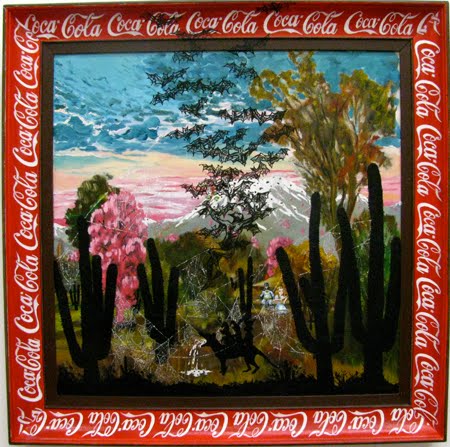
You recontextualise a lot of commercial images like the Coca-Cola logo, Batman and more, but not in a kitschy advertising subversion, rather you seem to lend new meaning to their context in Australian culture. What is your attitude towards commercialism? Destroy or propagate?
Things like these already contain a reading, which is often loaded and layered if scrutinised. Super heroes (like Batman), I feel, are a form of advertising. They sort of represent the American dream and its popular culture/mythology. I love the lurid flow and vibrancy of the coca cola logo and the way it is as wide spread as the pigeon. Everyone knows what it looks like and what it does whether they like it or not. I like a lot of commercials and products and dislike a lot too. I hate how ads scroll down your computer page when you are trying to read the news and you cant find the little cross to get rid of them. I guess we live in a commercially saturated world where ads are as much news as news is. Its all pretty stimulating and fantastic anyway.
Invaders of the Lost Art, 2010
What does the presence of decay mean to you in a piece like ‘Toy Painting (d-d-d-drop)’? And why the Beastie Boys, Claude Monet and Winnie the Pooh’s Piglet (covered in disintegrated flesh)?
The calf cow thing in d-d-d drop is kind of a piñata and winnie (sic) has fallen out of it along with all the milky ways after it was hit with the stick.
They are all toys, which I’ve used on a wider, multi narrative stage. a lot of them already have established narratives, positions and meanings in the collective consciousness, these all play a part in contributing to the ideas and meaning of their new surroundings. Within a new context, next to or used in new scenarios, they are likely to force a new understanding, whether about it in its original context or about an Idea which arises in its new context, which may have intentionally come about or by chance revealed itself.. Decay, is prevalent in the work as it is essentially a dead object. Natural elements wont decay the painting/materials over a short time with the conservation of artwork making them last perhaps thousands of years beyond myself, which I have trouble accepting. So, I have incorporated that as a kind of acknowledgment of my own mortality and that of the painting, and by killing or mummifying the image I find it easier to accept that, I’m getting older, decaying and one day I’ll die and fuck you painting, I’ll kill you before you kill me, but im glad you will live on. Its also always in there as a genuine concern for the direction of mankind as it seems a bleak future, but this is uncertain? It could just be what we are convincing ourselves on based on what we seem to understand through modern science and history. But we do know this will end some time so they are meant to be like they are already relics of mans existence, as though they have been found well after man has died. Perhaps by a new or visiting species?
Chalk Horse is a contemporary art gallery based in Sydney, Australia. The gallery exhibits a range of work by Australian and international artists. The Directors of Chalk Horse are committed to producing curatorial projects in Australia and Asia as well promoting Australian artists internationally.