Showing posts with label Chalk Horse. Show all posts

Friday, November 4, 2011

GREGORY & WATTS SUPPLEMENT GARY CARSLEY'S 'GARDENESQUE' at CACSA

GREGORY & WATTS FEATURE AUDIO GUIDE IN

GARY CARSLEY'S
'GARDENESQUE'

5 NOVEMBER - 11 DECEMBER, 2011
CACSA, SOUTH AUSTRALIA

The exhibition 'Gardenesque' represents an overview of the Gary Carsley's recent practice, specifically configured for the CACSA gallery. As a central focus of his pratice, the artist creates large scale digital photographic works created by scanning wood grain laminates which are then used to create highly textured composite images of public gardens and parks. The artist terms the resultant images Draguerrotypes, referencing both the nineteenth-century photographic technique as well as the garden as a drag performance: a site of constant negotiation between nature and culture. Other more recent works include the presence of a black, painterly silhouette in the foreground of these photographic collages. In this series of works the absence of the statue figure relates directly to postcolonialist ideals, addressing the unique position of Australia in relation to European history and our position within the Asia-Pacific region. 

Alongside the work of Gary Carsley, Gardenesque will feature a specially commissioned audio guide by Chalkie's very own Sydney-based artists/theorists Tim Gregoy and Oliver Watts, downloadable here.


Thursday, November 3, 2011

CLIFTON MACK WINNER OF RBS EMERGING ARTIST AWARD 2011!

On the 31st of October, 2011, Clifton Mack won the 2011 Royal Bank of Scotland Emerging Artist Award for his acrylic on canvas Jarman Island Sunset III. Mack received a $10,000 cash prize, a round-the-world airline ticket and also a place in an international development program.

Macks work uses a Pilbara sytle to render a coastal environment in warm, natural colours. It's one of a number of recent works that depict the Jarman Island Lighthouse. Mack’s choice of subject matter reflects both his ties to the local community and the area’s colonial history – the lighthouse is a symbol of navigation and trade, but also of strategic mapping and ownership. 

Clifton Mack, Jarman Island Sunset III, 2010, Acrylic on canvas, 76 x 122 cm.

Wednesday, November 2, 2011

Tuesday, November 1, 2011

OFFSITE EXHIBITION: 'FROM A CITY FORSAKEN BY ITS GODS' at FIRSTDRAFT


'A CITY FORSAKEN BY ITS GODS'

BOYCE/BREHAUT 
ROBERT HOOD 
JAMES ORAM

CHALK HORSE IN COLLABORATION WITH FIRSTDRAFT
2 - 20 NOVEMBER, 2011

“Newton was not the first of the age of reason: He was the last of the magicians.” 
- John Maynard Keynes

There is no general curatorial intent for this show. All the artists: Boyce/Brehaut, Robert Hood and James Oram, hail from New Zealand and Christchurch in particular, the town flattened by earthquake. The rebuilding has begun in the city and there has been support and gifting from the State and beyond; part of this help includes cultural endowments and this has helped our travelling exiles.


Although then not curated together as such, the contents of this exhibition share an oscillation between the material and the ideal; the socially embedded and the fantastical. They are on the cusp of reason and the irrational. Everything here works through a kind of image magic. What also connects them is a knowing interrogation of the place of art in the society. There is playful humour and satirical edge to the works.

Robert Hood regularly annexes his practice to prominent (and/or arcane) cultural artefacts and art genres. His works characteristically exist in a sort of symbiosis with hosts that are robust enough to bear a bit of good-natured parasitism. In ‘Broken Kilometre’, a master work shown recently elsewhere Hood apes Walter de Maria’s ‘Broken Kilometre’, now set up in the de Maria’s New York studio. Hood’s installations are in fact ‘broken’ road markers. The high seriousness of minimalism is countered in a neo-minimalist inversion. In ‘Untitled (Bucket on a pole, mop & towel)’’, is minimalism again to be seen? Or is it perhaps an obelisk declassed? No doubt what functions in Hood’s work is the tension between the grand and the silly. Like interrogative words attached to declarative text Hood’s objects hijack their subject’s established intent and divert a portion of its ‘substance’ toward confounding and revelatory ends.

In Roger Boyce and Marie-Claire Brehaut’s ‘Nature Morte’ the artist’s studio is conflated with a bedroom methamphetamine laboratory; the alchemy of paint is connected provocatively to the chemistry of transgressive drug manufacture. But weren’t the first artistic studios also alchemical studios? Painters would distil and mix their own colours from chemical powders, cutting and mixing certain hues together. The magic of creation also suggests the process of the alembic. Another strange transformation has occurred, more materially: in New Zealand the work was considered a ‘P-Lab’ (Vitamin P?) whereas here, in Australia it metamorphoses subtly into an ‘Ice-Lab’ which also has new poetic resonances. The painting series ‘The Illustrated History of Painting’ by Boyce, recently acquired by Christchurch Art Gallery, also relates to these questions of the ontology of art and the processes in the studio.

It is a simile that expands beyond the formal, dimensional and pictorial mimicry of sprawling bottles and tubes - which characterise both set-ups - hinting at an overlap of art, science and psychotropic substance. The artists describe the work as a tableau mort, referencing the stasis and opulence of Victorian tableau vivant, but entertaining both dead and deadly subject matter. The artifice of the Ice-Lab apparatus is exposed through its mirroring on canvas and vanity as a perverse sort of still life. In turn, the artists present us with a contemporary memento mori.


James Oram has a ‘bad’ habit of setting-up (existential) situations wherein a hapless ‘actor’ (often the artist himself) is bound to fail. The audience for his staged failures looks helplessly on - like voyeuristic (and cringing) motorists slowing past a series of personally embarrassing ‘pileups.’ The video work ‘Game Face’, 2O1O, puts us uncomfortably close to a performance of a set of ‘I AM’ self-affirmations. There is a sense of the endless struggle in a futile battle, as the oral stumbling block of a mouthguard becomes a constant obstacle in the recital process. The statements, as is the case in the lists from which which they were taken (internet self help websites), begin with basic self belief/ confidence/ relationship improvement and work their way towards building you up to dominating your peers, achieving wealth, career success, and so on. The mirrored profile of the mandible/maxilla as each affirmation is made creates a ripple effect from the significance of the words, to their oration, to the spit that forms a fervent slather.

In ‘Meeting’ a similar repetitive loop is played out, of handshakes filmed in slow motion, making visible the subtle re-grippings, power plays, tender finger draggings and the often overlooked tensions between the white knuckles of the assertive gripper and the crushed fingers of the meek. Through its isolated presentation the most universal of all greetings takes on a new gravitas and the subtleties of difference that are highlighted speak to wider concerns.

Oram’s work acts out a clear oscillation that allows for a rupture between everyday nothingness and the profound. Small actions (breathing, reciting, greeting) become signifiers of macrocosmic forces outside the gallery: of activity and failure; hope and despair; creation and destruction. Working heterogeneously across time-based media, objects, drawings and installation his varied working methods rely, for consistency, on painstaking (and pain giving) conceptual reiteration. Oram’s gimlet-eyed social commentary provides a punishing blow-by-blow commentary on the inevitably lost battles of human existence.

A way of looking and interacting connects the works in this show rather than any curatorial intent. Although all good art has this binary of the material and the ideal, these artists have a practice that demands a poetic moment of re-imagining. The viewer needs to resize, re-conceptualise (temporally and spatially), re-construct historically, revisit, in relation to the work but beyond it.


Boyce/Brehaut, Nature Morte, 2010, Mixed media. (Installation shot)
James Oran, Game Face, 2010, Film Still. 
Robert Hood, Untitled (Bucket on a pole, mop & towel), 2011. (Installation shot)

Wednesday, October 26, 2011

SOPHIA HEWSON 'THE LONGING: IT'S LIKE VULCAN BUT SAD'

27TH OCTOBER - 20TH NOVEMBER, 2011
CHALK HORSE

“Certain thoughts are prayers. There are moments when, whatever be the attitude of the body, the soul is on its knees.”

- Victor Hugo, Les Miserables: Chapter IV, 1862

Sophia Hewson’s adoption of her subjects enables re-enactments of past histories and mythologies, which in turn offer an updated iconography. Highly finished paintings and sculptures succeed in conjuring the religious and mytho- logical, but on the other hand speak directly to an unmistakable Pop aesthetic. A dichotomy is being played out: the seriousness of the content is carried through the titles, yet they are also being confused by a kitsch presentation. I can feel myself forming (my borrowed rib), But like a slug I am mighty to men gives us a naked and crying Virgin Mary wearing a synthetic polymer veil, a fluffy halo and a plastic flashing heart around her neck, uncannily realistic in its rendering this character could well play a part in one of LaChapelle’s tableaux.

Aligning itself nicely with the Hyperreal of the 198O’s & 9O’s, Hewson’s painting presents the subject in a way that distances the object from the artist. Authorship is confounded, the ‘hand of the artist’ is not represented by a gestural brushstroke, and a thick layer of resin serves to further create a barrier between the signi- fier and the signified. Bound in a thick, syrupy resin, like prehistoric insects in amber, Hewson’s subjects are perpetually suspended, preserved and distanced. But almost paradoxically through this shiny surface, and iconicity, the Sublime and spiritual seem to be suggested.

Both the content and process embodied in these works pushes towards a cathartic redemption from an inexplicable, omnipresent, malady. Hewson attempts to find a means of genuine salvation and spiritual elation, and through doing so simultaneously captures the sadness or mourning that is embedded within the inevitable inability to find such fulfillment. This ‘longing’ is present in the show’s title which pays homage to a small planet thought to have been discovered by a French mathematician in the 19th Century. The planet, named Vulcan, was soon disproved to exist. This hypothetical world whose life was so short speaks of an ontological yearning for something that has not truly been lost but has left a void regardless.

It could be argued that in our secular and multicultural society shared values as outlined by the codex have dissipated and been replaced by the popular, the common, the everyday. Is Sophia Hewson’s art calling for a contemporary reading of religion and universal, traditional values? Or is it all surface, where Madonna is more likely to conjure the pop icon rather than the religious? Neanderthal Christ, suspended in a structureless crucifixion, carries the gravitas of Renaissance art history yet also taps into a shared knowledge: that of hundreds & thousands on fairy bread, or cupcakes, an ingredient that can be sourced from any supermarket.

Similar is her approach to Help me Saint Teresa of Avila, with the saint presented as a Renaissance-like tondo sculpture, carved by hand and then cast. St. Teresa, a Carmelite nun and Spanish mystic, is famed for the religious ecstasy she experienced during a bout of feverish illness. Outlined in her own writings, St. Teresa claimed four stages in the path to achieve union with God. These steps to ascent followed moments of increased intensity in mental prayer, culminating in “the devotion of ecstasy”, a climactic state involving the loss of consciousness to divine intoxication. Teresa claimed to have been visited by a seraph armed with a gold spear headed by a small fire, which he used to pierce her body numerous times, drawing out her entrails and leaving her in a state where “the pain was so great, that it made me moan; and yet so surpassing was the sweetness of this excessive pain, that I could not wish to be rid of it. The soul is now satisfied with nothing less”1.

It would seem that in the experience of the ‘unmanifested’, through sexual/spiritual ecstasy from tactile/cognitive sources, there is a reoccurring conjuncture with something darker that lurks beneath the surface. Perhaps it is the uncertainty of the experience, or the subconscious implications: the proximity between “la petite mort” and actual death, between pornographic orgasm and divine rapture. As Bataille says, “the bond between life and death has many aspects. It can be felt equally in sexual and mystical experience”2.

There is a tension in Hewson’s work between high seriousness and Pop, between pastiche and true experience. The work takes everything equally seriously, from the fashion photo to hagiography; as our contemporary experience takes in such a disorienting breadth. Hewson’s paintings and sculptures act as aides to help us understand and confirm the challenges of our late capitalist existence where we are often just set adrift, with little to hold onto.
- KAT SAPERA & OLIVER WATTS, 2O11 

[1. St Teresa of Avila: El Castillo Interior, 1577
2. Georges Bataille: Death & Sensuality, 1986]


I can feel myself forming (my borrowed rib), But like a slug I am to mighty men, 2011, Oil & resin on board, 19O x 14Ocm.

Help Me Saint Teresa of Avila, 2011, Hand-carved polyurethane, hundreds & thousands, resin, 7O x 7O cm.

Neanderthal Christ, 2O11, Hand-carved polyurethane, hundreds & thousands, resin, 14O x 19O cm.


Thursday, October 6, 2011

OFFSITE PROJECT: ADAM GECZY 'DIASPORA GATHERED' at FIRSTDRAFT DEPOT

ADAM GECZY
'DIASPORA GATHERED'

CHALK HORSE IN COLLABORATION WITH FIRSTDRAFT
7 OCTOBER - 5 NOVEMBER, 2011

Adam Geczy is both an artist and critic-historian. His art practice has been dominated by multimedia installation and video, but he also exhibits regularly in areas of drawing and photomedia. Salient issues have been how to represent political dissent in a non-literal way, and traditional issues of love, death, loss and the fundamental nature of human tactile experience. Recent works have also used beauty as a positive response to disaffection with social alienation. He also has an active ongoing collaborative practice with the performance artist Mike Parr, Australia’s National Treasure, the composer Peter Sculthorpe and the Berlin-based electronic sound composer and installation artist, Thomas Gerwin. 


'Diaspora Gathered' is a project with the Australian Armenian community, and was opened by the Hon. Ms. Gladys Berejiklian, Transport Minister for NSW. Berejiklian spoke very movingly and eloquently about the Armenian Holocaust and the subsequent diaspora. Certain members were moved to tears recalling the horrors of the event and were happy that an artist like Adam Geczy was addressing the terrible Armenian past, and bringing it to greater recognition. See images below, in reference to the opening night and Berejiklian's inaugurating speech. 


Wednesday, September 28, 2011

Greedy Hen 'Debut Album'

29 SEPTEMBER - 8 OCTOBER, 2O11
CHALK HORSE

Greedy Hen’s first solo art exhibition sees the release of their fictitious Debut Album in 2O11. Titled ‘Debut Album’, this exhibition is a meditation on an ultimate SuperFiction1: ‘Greedy Hen as a band’. Utilising all of the usual visual cues, processes and linguistics that signify the release of an album (including gig posters and album launch advertising in the local music street press) Greedy Hen aim to translate this SuperFiction to an art gallery context. Exaggerating their own image in creating the illusion of ‘Greedy Hen as a band’ sets the direction of the exhibition, which centers on the mythical ‘debut album’. The exhibition will comprise of album artwork (translated to large scale prints) complete with song titles, a music film clip of their fictitious hit single release, artwork to narrate the lyrical content for each song. There will be no actual music or sound element in the show, leaving the void for the viewer to ‘fill it in’.

Greedy Hen is a multi-disciplinary studio functioning partly as an art collective and partly as a design studio, housing the collaborative works of Australian artists Katherine Brickman and Kate Mitchell. They devise projects intent on creating imagery alluding to a playful black humour, unwritten fables, or subtle off-kilter sinister elements lurking amongst a kinder-esq beauty. Greedy Hen’s work falls between the boundaries of traditional fields. They utilise various mediums preferring to let their ideas manifest in whatever way seems to be most appropriate at the time. Acting as a social sieve presenting the quirky nuances hidden in the everyday.

As a design studio, their work has graced the covers of many band’s albums, tour posters, and film clips, including work for Cloud Control, Ariel Pink, Florence + The Machine, Animal Collective, Washington, Bill Callahan (Smog) and The Middle East. The Waifs, Washington and Josh Pyke.


Debut Album Back Cover, 2O11, Digital pigment print on archival quality watercolour rag, Edition of 1O & 2 APs, 3O.5 x 3O.5 cm.
Debut Album, 2O11, Digital pigment prints on archival quality watercolour rag, Edition of 1O & 2 APs, 3O.5 x 3O.5 cm.

Everywhere, 2O11, Digital pigment print on archival quality watercolour rag, Edition of 1O& 2 APs, 84 x 119 cm.

Gnarly Beard, 2O11, Digital pigment print on archival quality watercolour rag, Edition of 1O& 2 APs, 15 x 21 cm.

Gravity, 2O11, Digital pigment print on archival quality watercolour rag, Edition of 1O & 2 APs, 59.5 x 84 cm.

Is This a Library or a Bar, 2O11, Digital pigment print on archival quality watercolour rag, Edition of 1O & 2 APs, 42 x 59.5 cm.

Log, 2011, Digital pigment print on archival quality watercolour rag, Edition of 1O & 2 APs, 42 x 59.5 cm.

Lonesome Country Song (Hotel Vacancy), 2O11, Digital pigment print on archival quality watercolour rag, Edition of 1O & 2 APs, 3O.5 x 3O.5 cm.

New Colours, 2O11, Digital pigment print on archival quality watercolour rag, Edition of 1O & 2 APs, 59.5 x 84 cm.

The Final Visit, 2O11, Digital pigment print on archival quality watercolour rag, Edition of 1O & 2 APs, 42 x 59.5 cm.

The Secret Level, 2O11, Digital pigment print on archival quality watercolour rag, Edition of 1O & 2 APs, 42 x 59.5 cm.

Tuesday, August 16, 2011

RECENT PRESS - Adam Cullen


Adam Cullen - 'Independent Judiciary (Mother's Milk)' in association with Michael Reid at Elizabeth Bay, curated by Andre de Borde and Jasper Knight

AS SEEN IN SMH


'Cullen aims for the brutal beauty of ballistics'
Adam Fulton, August 17, 2011


SEE VIDEO


ADAM CULLEN'S detractors have been trying for years to shoot down his work. Now he has beaten them to it.


For his latest exhibition the maverick artist lined up spray cans and paint tubs on top of a television. Behind them he placed large canvases with crude bull's-eyes. Then he started firing bullets, sending splatters of colour and debris onto the white backdrops.

The ballistic exercise on a rural property near Goulburn was filmed and the footage is being shown in Chalk Horse's spiffy new gallery along with the two lashed canvases, a bullet-riddled smaller panel and a textual reference to the death of his mother a year ago.

"Look at this, mate, this is huge," Cullen says admiringly as he moves a finger around a hole the size of a fist, one of many dotting the canvases.

''This whole thing, I suppose, is some form of lactic exercise in ballistics. So it's sort of lactic ballistics. It's like, if you can imagine, tits as guns. Thus the title,'' he says of Independent Judiciary (Mother's Milk)....


READ MORE
_______
AS SEEN IN DAILY TELEGRAPH


'Cullen aims for the brutal beauty of ballistics'
Adam Fulton, August 17, 2011


... Yoko Ono and the late William S. Burroughs have used ballistics in art. American artist Chris Burden was once shot in the arm as a deliberate part of an art performance.
But Cullen says no other Australian artist has created paintings with guns.

The exhibition of paintings, titled Independent Judiciary (Mother's Milk), is on view from today at Chalk Horse, where Clementine Blackman is gallery manager.
Cullen, who has delighted in delivering artistic shocks since his student days, is clearly chuffed to be showing at Chalk Horse.In Sydney, Cullen normally shows his work at the upmarket Michael Reid gallery at Elizabeth Bay. But Reid was happy to collaborate with Chalk Horse on this exhibition, since his gallery was too small to house it.
Cullen, who has delighted in delivering artistic shocks since his student days, is clearly chuffed to be showing at Chalk Horse. It shows that, in his mid-40s, his art is still experimental enough for a gallery in touch with its roots as an artist-run space...


Thursday, August 11, 2011

Sanne Mestrom wins John Fries Memorial Prize 2011 (VISCOPY)

Sanné Mestrom, Thinking Props, 2010
120x100x100cm 
Mixed media sculptural installation

Viscopy is pleased to announce Sanné Mestrom the winner of the John Fries Memorial Prize 2011 for emerging visual artists.  Mestrom received the $10,000 prize at the opening of the exhibition of the fifteen finalists last night at Blackfriars off Broadway, Viscopy’s contemporary art space in Chippendale. The prize was awarded by acclaimed Sydney artist, Lindy Lee.
 

Mestrom's winning artwork, Thinking Props features in the exhibition with the other fourteen finalists: Cyrus Tang, Erica Molesworth, Eva Hampel, Heath Franco, Jennifer O'Brien, Karl Khoe & Tessa Zettel, Keiko Matsui, Kristel Britcher, Kurt Sorensen, Nathan Taylor, Pauletta Kerinauia, Sanné Mestrom, Susie Nelson, Wade Marynowsky and Walter Brecely.

The winning entry was selected by an auspicious panel of judges including Anna Davis, media artist and Museum of Contemporary Art curator, Hannah Bertram the 2010 John Fries Memorial Prize winner, Danie Mellor contemporary Indigenous artist and 2009 National Aboriginal & Torres Strait Islander Art Award winner and Kath Fries, artist and Viscopy Board member.


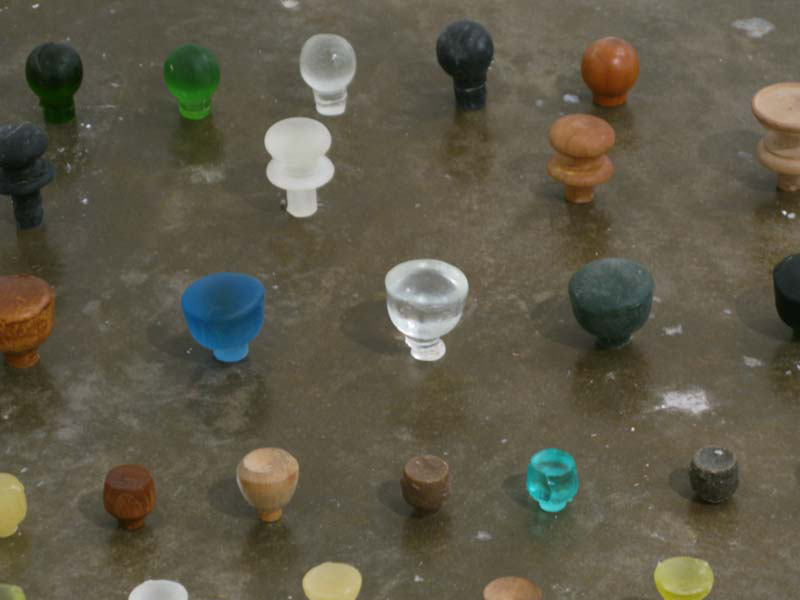
Mestrom's sculptural installation Thinking Props plays with the idea of a physical prop designed to promote cerebral and psychological contemplation.   Made from everyday found objects, the work consists of three components: a table, a cluster of door handles and a “joy prop”.  Her table is tailored to one assuming the classic position of Auguste Rodin's The Thinker, with elbow placed on table enclave and chin on cupped hand.  It is a physical prop that encourages cerebral revelation.  A grid of door handles below the table suggests opening doors, that endless possibilities and zones of discovery are just a simple action away.  In front of the table sits a “joy prop” constructed of a cast bronze mould hypothetically designed to be fitted into the mouth to force a smile.


Danie Mellor says of the Mestrom’s artwork: “In her winning entry for the 2011 John Fries Memorial Prize, Mestrom engages with the everyday and what she terms ‘psychological props’.  Through her interest in human intimacy and this field of research and play in her practice, she presents playful and thought provoking arrangements of objects that recall Modernist engagements with the readymade. The difference with her work by comparison though, is that an intimacy is invoked that allows a bodily interaction with form, if only through the viewers’ realisation that in fact ‘this is what you (can and are supposed to) do’ with the objects.  They are both familiar and out of reach as fragile objects in a gallery space, a temptation for the curious. The complexity of the potential interaction that the installation suggests, and its resolution as an intricate and multi-layered object, lends this work its intrigue and place as a well deserving winner.”

The exhibition, curated by Venita Poblocki, runs until 30 September and is open between 1pm and 5pm from Wednesday to Friday.
 

The John Fries Memorial Prize for emerging visual artists is an annual prize donated by the Fries family in memory of former Viscopy director and honorary treasurer, John Fries, who made a remarkable contribution to the life and success of Viscopy.  The competition is open to emerging Australian and New Zealand artists of all ages and disciplines who are not represented in a regional, state, territory or national public art collection.

For further information contact Viscopy on (02) 9310 2018.